
Job Safety Analysis | Safety blog

Hello Readers,
This blog explains the basic concepts of JSA – Job Safety Analysis, which is performed before starting hazardous or high-risk work to identify potential hazards and implement effective control measures.
In this article, we will study Job Safety Analysis (JSA), its importance, and how it helps improve workplace safety.
[ads id="ads1"]Index – Job Safety Analysis | Safety Blog
-
Purpose and Definition of JSA
-
Fundamentals of Hazard Identification
2.1 What is a Hazard
2.2 Types of Workplace Hazards
2.3 Hazard vs Risk -
When Job Safety Analysis Should Be Conducted
3.1 New Job or Task Introduction
3.2 Non-Routine or High-Risk Activities
3.3 After Accidents or Near Misses
3.4 When Equipment or Process Changes -
Breaking a Job into Task Steps
4.1 Importance of Proper Task Breakdown
4.2 Identifying Key Work Steps
4.3 Avoiding Too Many or Too Few Steps
4.4 Examples of Task Breakdown in Industrial Jobs -
Hazard Identification During JSA
5.1 Mechanical Hazards
5.2 Chemical Hazards
5.3 Electrical Hazards
5.4 Physical Hazards
5.5 Ergonomic Hazards -
Risk Evaluation in JSA
6.1 Understanding Risk Level
6.2 Likelihood and Severity Concept
6.3 Risk Rating Matrix
6.4 Prioritizing High-Risk Tasks -
JSA Documentation and Format
7.1 Standard JSA Form Structure
7.2 Key Elements of a JSA Document
7.3 Writing Clear and Practical Control Measures
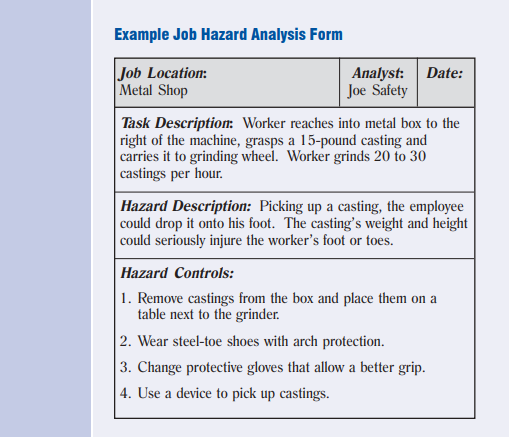
7.4 Example of a Completed JSA
1. Purpose and definition of JSA
Definition
Job Safety Analysis (JSA) is a systematic safety technique used to analyze a job by breaking it into small steps to identify potential hazards and implement safe working procedures to prevent accidents.
Purpose of JSA
• Identify hazards associated with each step of a job
• Develop safe work procedures before starting the task
• Prevent accidents, injuries, and equipment damage
• Improve planning and safety awareness among workers
• Establish safe working conditions and safety rules
When JSA is Used
• During planning and design of plant, machinery, and processes
• Before starting new or hazardous jobs
• When changing or improving work methods
• During workplace inspections and safety reviews
Basic Procedure of JSA
- Select the job to be analyzed
- Break the job into logical task steps
- Identify hazards in each step
- Develop control measures to eliminate or reduce risks
Hazard Minimization Methods
• Use safer or alternative working methods
• Improve workplace conditions causing hazards
• Eliminate or reduce hazards through engineering controls
• Use appropriate Personal Protective Equipment (PPE)
2. Fundamentals of Hazard Identification
3. When Job Safety Analysis Should Be Conducted
3.1 New Job or Task Introduction
• Conduct JSA when a new job, operation, or process is introduced.
• Common during installation of new equipment, new production lines, or new chemical handling activities.
3.2 Non-Routine or High-Risk Activities
• Required for jobs that are not regularly performed or involve high risk.
• Examples include confined space entry, hot work, line breaking, and reactor or tank maintenance.
3.3 After Accidents or Near Misses
• JSA should be reviewed after incidents or near misses.
• Helps identify unsafe steps and root hazards.
• Allows improvement of procedures to prevent recurrence.
3.4 When Equipment or Process Changes
• Required when equipment, chemicals, or process conditions change.
• Examples include new machinery, modified pipelines, or process upgrades.
• Ensures new hazards are identified and controlled.
4. Breaking a Job into Task Steps
4.1 Importance of Proper Task Breakdown
- Job Safety Analysis requires dividing a job into clear and logical task steps.
- Proper breakdown helps identify hazards at each stage of the job.
- In industries, tasks often involve hazardous chemicals, pressure systems, and complex equipment.
- Step-by-step analysis improves hazard identification and safety planning.
- It helps workers clearly understand the work sequence and required safety precautions.
- Proper task breakdown reduces the risk of accidents, chemical exposure, fire, and equipment failure.
4.2 Identifying Key Work Steps
- Key work steps are the major actions needed to complete a job safely.
- Each step should represent an important activity in the work process.
- Examples include opening valves, starting pumps, charging reactors, sampling materials, or cleaning equipment.
- Steps should follow the actual sequence of the operation.
- Identifying correct steps helps analyze hazards such as chemical spills, pressure release, mechanical hazards, or toxic exposure.
4.3 Avoiding Too Many or Too Few Steps
- Task steps should be clear, practical, and easy to understand.
- Too many steps can make the analysis complex and difficult to follow.
- Too few steps may miss important hazards and safety controls.
- Steps should represent logical stages of the job.
- In industrial operations, common stages include preparation, operation, monitoring, and shutdown.
4.4 Examples of Task Breakdown in Industrial Jobs
-
Chemical Transfer Operation
- Inspect pipeline and transfer line
- Connect transfer hose
- Open valves and start transfer
- Monitor flow and pressure
- Close valves after completion
- Disconnect hose safely
-
Reactor Charging Process
- Verify raw materials and batch details
- Check reactor condition and cleanliness
- Add chemicals into reactor
- Start agitation and mixing
- Monitor temperature, pressure, and reaction progress
-
Equipment Maintenance
- Isolate equipment from process line
- Apply lockout and tagout procedure
- Depressurize and drain system
- Perform maintenance work
- Reassemble equipment and test operation.
5. Hazard Identification During JSA
5.1 Mechanical Hazards
- Mechanical hazards come from moving or rotating parts of machines and equipment.
- Common sources include pumps, compressors, agitators, conveyors, and rotating shafts used in industrial plants.
- Risks include entanglement, crushing, cutting, or impact injuries.
- Maintenance work on reactors, mixers, and production equipment also increases mechanical risk.
- Proper machine guarding, lockout–tagout procedures, and safe operating practices are essential controls.
5.2 Chemical Hazards
- Chemical hazards are very common in chemical, pharmaceutical, and petrochemical industries due to handling of hazardous substances.
- Risks include toxic exposure, skin burns, inhalation of vapors, and chemical reactions.
- Examples include acids, solvents, flammable liquids, corrosive chemicals, and toxic gases.
- Activities such as chemical transfer, reactor charging, sampling, and cleaning operations increase exposure risk.
- Proper PPE, ventilation, safe handling procedures, and knowledge of Safety Data Sheets (SDS) help control chemical hazards.
5.3 Electrical Hazards
- Electrical hazards occur from contact with energized equipment or faulty electrical systems.
- Industrial plants use high-voltage motors, control panels, instrumentation systems, and power distribution units.
- Risks include electric shock, burns, arc flash, and fire.
- Maintenance, wiring work, or operating damaged electrical equipment increases the danger.
- Lockout–tagout, proper insulation, grounding, and qualified electrical work practices help reduce electrical risks.
5.4 Physical Hazards
- Physical hazards come from environmental or operational conditions in the workplace.
- Common examples include excessive heat, noise, vibration, radiation, high pressure, and confined spaces.
- In petrochemical and chemical plants, high-temperature reactors, steam lines, and pressurized systems are major sources.
- These hazards can cause burns, hearing loss, fatigue, or serious injuries.
- Monitoring workplace conditions and using proper protective equipment help control these risks.
5.5 Ergonomic Hazards
- Ergonomic hazards arise from poor body posture, repetitive tasks, or manual handling of materials.
- Workers may face strain while lifting bags of raw materials, handling drums, or performing repetitive packaging operations.
- Long working hours in awkward positions during maintenance or laboratory work can cause muscle and joint injuries.
- Proper lifting techniques, ergonomic tools, and improved workplace design help reduce these risks.
6. Risk Evaluation in JSA
6.1 Understanding Risk Level
- Risk level shows how dangerous a hazard can be during a job task.
- It helps determine the chance of an accident and the seriousness of its impact.
- In industries, risks may include chemical leaks, fire, explosion, toxic exposure, equipment failure, or pressure release.
- Evaluating risk helps safety teams decide what control measures are required before starting the job.
- Proper risk evaluation improves safe work planning and reduces workplace incidents.
6.2 Likelihood and Severity Concept
- Risk evaluation is based on two main factors: likelihood and severity.
- Likelihood means the chance that a hazard may cause an accident.
- Severity means how serious the injury, damage, or loss could be if the hazard occurs.
- For example, a small chemical splash may have low severity, while a reactor explosion has very high severity.
- Combining likelihood and severity helps determine the overall risk level of a task.
6.3 Risk Rating Matrix
- A risk rating matrix is a tool used to calculate and classify risk levels.
- It compares the likelihood of an incident with its severity to assign a risk rating such as low, medium, high, or critical.
- In industrial plants, this matrix helps safety teams evaluate hazards in operations like chemical transfer, reactor operation, equipment maintenance, and confined space entry.
- The matrix provides a structured method to analyze risks and decide proper safety controls.
6.4 Prioritizing High-Risk Tasks
- High-risk tasks must be identified and controlled before work begins.
- In chemical and petrochemical plants, tasks like hot work, confined space entry, working at height, and handling flammable or toxic chemicals are considered high-risk.
- These tasks require strict safety procedures, permits, supervision, and proper protective equipment.
- Prioritizing high-risk activities ensures that the most dangerous jobs receive maximum safety attention and control measures.
7. JSA Documentation and Format
7.1 Standard JSA Form Structure
- A Job Safety Analysis (JSA) document follows a structured format to record job steps, hazards, and safety controls.
- In chemical, pharmaceutical, and petrochemical industries, the JSA form helps ensure that hazardous operations are properly reviewed before work begins.
- A standard JSA form usually includes job title, work location, department, date, team members involved, and approval details.
- The main section of the form is arranged in columns such as task steps, hazards identified, and control measures.
- This structured format makes the document easy to review, communicate, and implement at the worksite.
7.2 Key Elements of a JSA Document
- Basic job information
- job name
- plant area
- responsible department.
- List of job steps arranged in the correct sequence of work.
- Hazards identified for each step, including chemical, mechanical, electrical, or environmental hazards.
- Control measures required to reduce or eliminate risks.
- Required personal protective equipment (PPE) and safety precautions.
- Names of employees involved and supervisor approval for the job.
7.3 Writing Clear and Practical Control Measures
- Control measures should be simple, practical, and easy for workers to understand.
- They must clearly explain how to prevent accidents during the task.
- Examples include isolating equipment, using lockout–tagout procedures, wearing proper PPE, ensuring ventilation, and following safe operating procedures.
- In process industries, controls may also include pressure checks, gas testing, grounding, or emergency response preparation.
- Clear control measures help workers follow safe practices during hazardous operations.
7.4 Example of a Completed JSA


Frequently Asked Questions
1. What is Job Safety Analysis (JSA)?
Job Safety Analysis (JSA) is a systematic safety method used to identify hazards associated with a specific job and to implement control measures to perform the job safely.
It involves breaking the job into individual steps, identifying potential hazards at each step, and defining safe procedures to prevent accidents, injuries, or equipment damage.
2. What is the main purpose of conducting a JSA?
The main purpose of conducting a JSA is to identify potential hazards before starting a job and implement preventive measures to reduce risks.
It helps establish safe work procedures, improve hazard awareness among workers, and prevent accidents, injuries, and process incidents in industrial operations.
3. What are the key steps involved in performing a JSA?
The key steps in performing a JSA are:
- Select the job that needs analysis
- Break the job into logical task steps
- Identify hazards associated with each step
- Evaluate the risk level of each hazard
- Develop and implement control measures to eliminate or reduce the risks
4. What is the difference between JSA and risk assessment?
Job Safety Analysis focuses on analyzing a specific job by breaking it into steps and identifying hazards at each step.
Risk assessment is a broader process used to evaluate risks associated with hazards in a workplace, process, or activity and determine the level of risk based on likelihood and severity.
5. When should a JSA be conducted in industrial operations?
A JSA should be conducted before starting new jobs, non-routine work, high-risk activities, maintenance work, or when changes occur in equipment, processes, or chemicals.
It should also be reviewed after accidents, incidents, or near misses to prevent recurrence.
6. Why is JSA important before starting hazardous work?
JSA is important before hazardous work because it helps identify dangers in advance and ensures that proper safety controls are implemented.
It allows workers and supervisors to understand the risks involved, plan safe procedures, and prevent accidents such as chemical exposure, fire, explosions, or equipment failures.
7. Who is responsible for preparing and approving a JSA?
A JSA is usually prepared by the supervisor or safety officer along with the workers who are performing the job.
It is reviewed and approved by responsible authorities such as the department supervisor, safety department, or plant management to ensure that all hazards and control measures are properly addressed.
8. What information is included in a standard JSA document?
A standard JSA document includes job title, location, department, date, names of workers involved, job steps, identified hazards for each step, required control measures, personal protective equipment, and approval signatures of supervisors or safety personnel.
9. How do you break a job into task steps during JSA?
A job is broken into task steps by observing the work process and dividing it into logical and sequential actions required to complete the job.
Each step should represent a meaningful activity such as preparing equipment, starting operation, monitoring the process, and shutting down safely.
10. Why is proper task breakdown important in JSA?
Proper task breakdown is important because it helps identify hazards at every stage of the job.
Clear and logical steps make it easier to analyze risks, implement control measures, and ensure workers understand the correct and safe sequence of performing the task.
11. What types of hazards are identified during JSA?
During JSA, different types of hazards that may cause harm during a job are identified.
These include mechanical hazards from moving equipment, chemical hazards from toxic or flammable substances, electrical hazards from energized systems, physical hazards such as heat or noise, and ergonomic hazards caused by manual handling or poor working posture.
12. How is risk evaluated during a JSA?
Risk is evaluated by analyzing the likelihood of a hazard causing an incident and the severity of its possible consequences.
Safety professionals assess how often the hazard may occur and how serious the injury or damage could be.
Based on this evaluation, appropriate control measures are implemented to reduce the risk.
13. What are likelihood and severity in risk evaluation?
Likelihood refers to the probability that a hazard will lead to an incident during a job task.
Severity refers to the level of harm or damage that could result if the incident occurs.
By combining likelihood and severity, safety teams determine the overall risk level of a hazard.
14. What is a risk rating matrix?
A risk rating matrix is a tool used to determine the level of risk by comparing likelihood and severity of a hazard.
It helps classify risks into categories such as low, medium, high, or critical.
This method allows safety teams to prioritize hazards and implement appropriate safety controls in industrial operations.
15. How do you prioritize high-risk tasks in a JSA?
High-risk tasks are prioritized by evaluating the likelihood of an incident and the severity of its consequences.
Tasks that can cause serious injury, fire, explosion, toxic exposure, or major equipment damage are given the highest priority.
The prioritization process generally includes:
- Identify hazards in each job step
- Evaluate likelihood of occurrence
- Evaluate severity of possible consequences
- Assign risk level and prioritize highest risks first
In process industries, activities such as confined space entry, hot work, chemical handling, and line breaking are treated as high-risk and require strict safety controls and work permits.
16. What control measures can be used to reduce hazards?
Control measures are implemented to eliminate hazards or reduce their risks during a job.
Industries follow a hierarchy of controls to ensure effective safety management. The hierarchy of control measures includes:
- Elimination – remove the hazard completely
- Substitution – replace with a safer alternative
- Engineering controls – guarding, ventilation, isolation
- Administrative controls – procedures, training, supervision
- Personal Protective Equipment – helmets, gloves, respirators
These measures help control risks related to chemicals, machinery, and industrial operations.
17. How does JSA help prevent accidents in chemical plants?
JSA helps prevent accidents by identifying hazards before the job begins and defining safe work procedures.
Each job step is analyzed to detect risks such as chemical exposure, equipment failure, or fire hazards.
This process improves worker awareness and ensures that proper safety precautions, PPE, and control measures are implemented before starting the task.
18. What role does PPE play in JSA control measures?
Personal Protective Equipment provides protection when hazards cannot be completely eliminated.
In JSA, PPE is specified based on the hazards involved in the task.
Common PPE includes helmets, safety goggles, chemical-resistant gloves, respirators, and protective clothing.
Proper PPE reduces exposure to chemical, physical, and mechanical hazards.
19. Why is lockout–tagout important in JSA?
Lockout–tagout is used to isolate machines and equipment from energy sources before maintenance or repair work.
It prevents accidental startup or release of stored energy.
Including lockout–tagout in JSA ensures safe maintenance activities and protects workers from electrical shock, mechanical movement, or pressure release.
20. How is JSA used in hot work activities?
JSA is used before hot work to identify fire and explosion hazards associated with welding, cutting, or grinding activities.
It ensures safety measures such as removal of flammable materials, availability of fire extinguishers, gas testing when required, and assigning a fire watch before issuing the hot work permit.
21. How is JSA applied in confined space entry?
JSA is conducted before entering confined spaces such as tanks, reactors, or vessels to identify hazards like toxic gases, oxygen deficiency, and limited ventilation.
Based on the analysis, safety controls such as gas monitoring, ventilation, standby personnel, and rescue arrangements are implemented.
22. How does JSA support work permit systems?
JSA supports the permit-to-work system by identifying hazards and defining safety precautions before a permit is issued.
The permit authority reviews the JSA to ensure required controls such as isolation, PPE, and supervision are in place before authorizing hazardous work.
23. When should a JSA be reviewed or updated?
A JSA should be reviewed when there are changes in equipment, processes, chemicals, or working conditions.
It must also be updated after accidents, near misses, or identification of new hazards. Regular review ensures that safety procedures remain effective and relevant to current operations.
24. How does JSA improve workplace safety and operational efficiency?
JSA improves safety by identifying hazards early and establishing clear safe work procedures.
Workers become aware of risks and follow proper safety controls during the task.
This reduces accidents, minimizes downtime, improves productivity, and strengthens the overall safety culture in industrial operations.